 Courtesy: Khabarhub
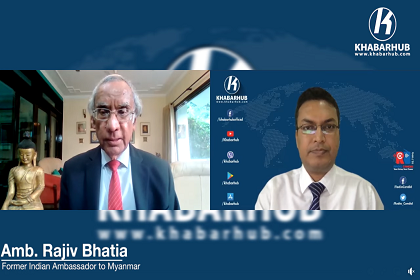
On 6 October 2021, Ambassador Rajiv Bhatia, Distinguished Fellow, Foreign Policy Studies Programme, spoke to Dr. Pramod Jaiswal, Strategic Affairs Editor at Khabarhub on the role of Nepal in BIMSTEC and SAARC, in an analysis of the 17th BIMSTEC ministerial meetings. He also highlighted the role of SAARC and BIMSTEC in countering Chinese influence in the region.
 Courtesy: Twitter | @AP
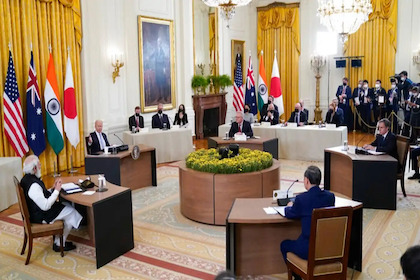
The first in-person Quad Leader's Summit drew global attention for its symbolism and substance. A critical analysis of its outcome shows that the institutionalisation of the organisation has begun. India has a chance to work with the advanced economies, on an equal footing and with much to contribute.
 Courtesy: Twitter | @narendramodi
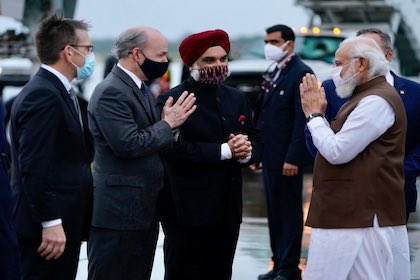
On September 24, the Quad leaders will attend the first in-person summit of the grouping in Washington DC. There is much to discuss for the four leaders, given recent developments: the Taliban takeover of Afghanistan, the Australia-UK-US (AUKUS) security partnership and the EU's new Indo-Pacific strategy. The Quad also needs to focus on long term goals like institutionalising itself and devising a strategy to counter the China challenge.
 Courtesy: Press Information Bureau, Government of India
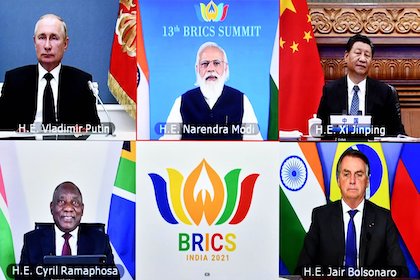
India hosted the 13th BRICS summit on September 9, celebrating 15 years of the multilateral. The leaders committed to fighting terrorism and reforming multilateral organisations, among other diverse aspects. However, the grouping clearly needs better implementation strategies if the agreements reached, are to be truly successful.
 Courtesy: BRICS Forum - India 2021
The 13th BRICS summit will be held virtually on 9 September 2021 and India is the host. The grouping has managed to hold its ground in an era of increasingly complex geopolitics. While immediate goals are important, in the longer term it must cooperate on counter terrorism, improve trade and work towards the Sustainable Development Goals.
 Courtesy: The Times of India
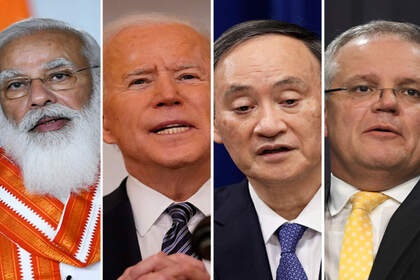
In an interview with Garrison Moratto of The New Diplomatist, Amb. Rajiv Bhatia, Distinguished Fellow, Foreign Policy Studies, counters China's claims that the Quad is an "Asian NATO." He highlights how the India-U.S.-Japan-Australia Quadrilateral initiative aims to increase cooperation in the Indo-Pacific on international law and security. This podcast delves into the history of the Quad's formation, current strategic characteristics, and future geopolitics, ahead of the fall in-person Leaders' Summit in the U.S.
 Courtesy: Flickr
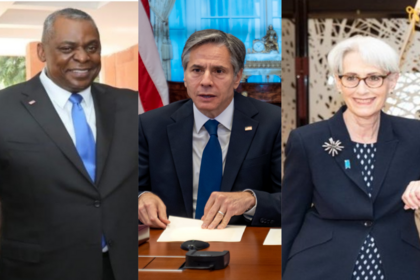
Three senior U.S. officials visited Asia in July in a well-choreographed diplomatic outreach strategy by the Biden administration. The U.S is willing to prioritise the Indo-Pacific and counter China. Asia cannot afford to be a reticent bystander.
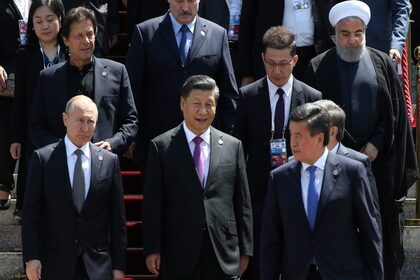 Courtesy: SCO, Russia (2020)
A potential anti-Quad formation of China, Russia, Iran and Pakistan is in the making, and can pose risks to the Quadrilateral Security Dialogue. However, a close analysis of China's bilateral relationship with each country shows that this is a flawed grouping, formed on limited common interests and rivalries.
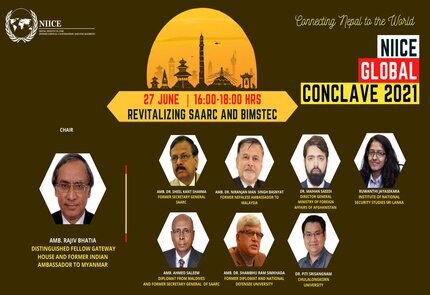 Courtesy: Nepal Institute for International Cooperation and Engagement
On 27 June 2021, Ambassador Rajiv Bhatia, Distinguished Fellow, Gateway House, chaired a session on Revitalizing SAARC and BIMSTEC. This was part of the Global Conclave 2021, hosted by the Nepal Institute for International Cooperation and Engagement (NIICE), Kathmandu. Bhatia spoke about the present state, past trajectory and future challenges and opportunities for regional and sub-regional cooperation through SAARC and BIMSTEC.
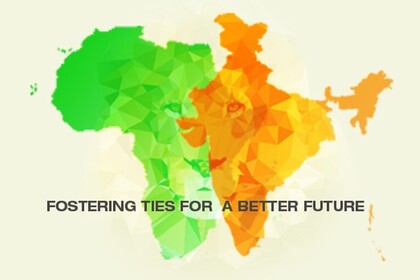 Courtesy: www.mapsofindia.com
Africa is a foreign policy priority for India, but evidence shows a recent decline in bilateral trade and investment. There is already a "third scramble" for geopolitical influence in Africa. Now is the time for India to make new commitments in the continent: developing and deepening links in health, space and digital technologies.